Monday, February 18, 2008

Our Traffic is Up


Thanks to all who are linking to us. We appreciate it.

Engineering: Past and Present

In chapter 1 we discuss engineering and its relationship to science. Below is a list of the 20th century's greatest engineering achievements from the National Academy of Engineering.

Great Engineering Achievements
  1. Electrification
  2. Automobile
  3. Airplane
  4. Water Supply and Distribution
  5. Electronics
  6. Radio and Television
  7. Agricultural Mechanization
  8. Computers
  9. Telephone
  10. Air Conditioning and Refrigeration
  11. Highways
  12. Spacecraft
  13. Internet
  14. Imaging
  15. Household Appliances
  16. Health Technologies
  17. Petroleum and Petrochemical Technologies
  18. Laser and Fiber Optics
  19. Nuclear Technologies
  20. High-performance Materials

Tomorrow's Challenges
  1. Make solar energy economical
  2. Provide energy from fusion
  3. Develop carbon sequestration methods
  4. Manage the nitrogen cycle
  5. Provide access to clean water
  6. Restore and improve urban infrastructure
  7. Advance health informatics
  8. Engineer better medicines
  9. Reverse-engineer the brain
  10. Prevent nuclear terror
  11. Secure cyberspace
  12. Enhance virtual reality
  13. Advance personalized learning
  14. Engineer the tools of scientific discovery
If after reading chapter 1 you are still wondering what we mean about the relationship of science and engineering, then look at the list and links above. Engineers have taken from science and provided many engineering solutions to human problems. However, there is much still to do.

Friday, February 15, 2008

Low blood sugar is deadly?

A portion of an ongoing diabetes study was recently halted when one of the groups experienced 54 more deaths than another. The group with the higher number of deaths was composed of diabetes patients who were asked to radically lower their blood sugar levels. The comparison group was also lowering their blood sugar levels, but not as much.

Nothing in the previous literature suggested that lowering blood sugar could be dangerous for diabetics, provided they did not do so abruptly.

Thus, the researchers deemed it necessary, on ethical grounds, to halt the part of the study where patients were attempting to lower their blood sugar levels to near the levels of a normal, non-diabetic person.

Read the New York Times article for more information. This study shows the necessity of monitoring data collection and making adjustments to protocols as necessary.

Sunday, February 3, 2008

Get the Lead Out

Here's another one of those old wives tales, except this time it turns out to be true. The tale is: Don't drink hot water from the tap. It turns out the old wives were right, this time.

A New York Times story, details why drinking hot water is dangerous. Hot water is more likely to contain lead, even in new homes. The hot water dissolves lead and other deleterious substances found in water pipes. The story points out that the risk is small, but why take chances.

More detailed information on lead and how to prevent lead poisoning can be found at the EPA's site on lead.

Friday, February 1, 2008

Metaphors for Undergraduate Research

I put a lot of stock in teaching research as a process. Planning research is an important part of the process and students often wish to begin collecting data as quickly as possible. Of course, careful planning is critical to the success of any research project and many of our students have to be reined back as they champ at the bit to start.

I used a Sisyphean metaphor for research originally, but students did not like it because it made research look like an impossible task. After they made their objections clear to me, I changed the metaphor to a more pleasant one.

Here is the original, not-so-pleasant view of research:

Like poor Sisyphus in Greek mythology, students saw their research efforts as an impossible task. The upslope represented the planning phases of research, while getting the ball to roll down the hill represented the collection and analysis of data followed by writing, presentation, and publishing.

So, I searched for a better metaphor. Something that indicated fun. Hmmmm.....
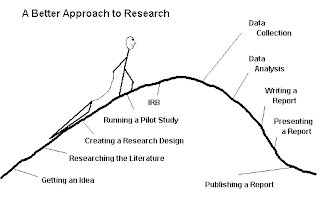


I kept the hill, but changed the task. Sledding is fun, but you have to get to the top of the hill first. On the figure on the right, I have labeled some of the specific tasks in research planning. The metaphor also reveals the timeline differences between planning research and conducting research.

Only after coming to grips with all of the aspects of research planning and testing them (in the Pilot Study), are researchers ready to collect data and undertake the remaining steps. Like sledding down the hill, these steps come at a faster clip than the steps in planning.

Students are pleasantly surprised once they begin to collect data. That process is usually faster than they expect. Carefully planned data analysis also can happen quickly. Sometimes it only takes a few minutes after the raw data are entered into a computer program. As deadlines loom, drafting and editing also speed by. The few minutes it takes to present a research report scarcely convey the long hours it took to get there.

For students who elect to publish their data, much more work awaits them. Maybe we can think of those efforts as climbing the next hill.

Saturday, January 12, 2008

Erratum-Page 286

Here is the first of what we hope will prove to be a very short list of errata.

Shawn Powell of Casper College wrote:

"I have a question on a formula and significance test results shown on page 286. What was the df for MS residual and the number of levels of the IV used to arrive at the probability figures near the bottom of the page. Using the charts provided on pages 449 and 450 (which by the way are shown as "-" in the text on page 286) I used a df of 18 and an IV level of 2 and arrived at .05 = 2.97 and .01 = 4.07. If this is correct then the values to the right of the formula don't match up with the results shown."

Chris Spatz responded:

"To determine correct HSD critical values, the number of levels of the IV is the number in the original ANOVA problem rather than the number in the HSD test. Thus, for the HSD tests on page 286, the number is 3 and not the 2 in the HSD test. I'm afraid that our last paragraph on the page really needs some improving. Our only clue to you to use 3 is the word ANOVA. Upon re-reading, it is clear that the insertion of the numbers needed for the critical values (df = 18 and number of levels = 3) would improve the communication of what we actually did."

In addition, there is a typographical error in the last paragraph of page 286. The first two sentences should read:

"To interpret HSD values, use Table C.5 in appendix C. Critical values for alpha = .05 are on page 449 (missing page number in original); those for alpha = .01 are on page 450 (missing page number in the original)."

Our thanks to Dr. Powell and his sharp eyes. If anyone else spots similar issues please contact us.

Monday, January 7, 2008

NHST

On page 169 in an In the Know box, we briefly discuss the history and current status of null hypothesis statistical testing (NHST). Naturally, we still teach NHST basics but we also emphasize newer methods such as exploring the data and using confidence intervals.

So, it was interesting to find what Irene Pepperberg had to say about NHST. You may recall Dr. Pepperberg as the psychologist who found and trained Alex, the African gray parrot, to communicate using a limited vocabulary. (See the earlier blog entry, "You be good, see you tomorrow..." where we covered Alex's death.)

Pepperberg was one of 165 scientists and others who had responded to Edge's 2008 question: What have you changed your mind about? Why? In her reply, she said she had changed her mind about NHST (although she does not refer to it as NHST, she calls it "the classic scientific method.")

She gives three reasons for her change of mind. The first is that she now realizes the importance of observation before forming testable hypotheses. The second is that some important and interesting questions about psychology do not lend themselves to easy conversion to testable hypotheses. The third is that she believes too many scientists, because of their methods training, end up seeking to prove hypotheses rather than testing them.

Here is the link to her full response.

Also, here are links to responses by other psychologists to the same question: David Buss, Howard Gardner, Diane Halpern, Daniel Kahneman, Stephen Kosslyn, and Martin Seligman. Many other scientists, thinkers, and celebrities also responded.